The sacroiliac joints — commonly called the SI joints — are where your spine connects to your pelvis, and they’re one of the most common sources of lower back and hip pain that Dr. French treats at his Norwalk, CT practice. When these joints are working correctly, you don’t notice them at all. When they’re injured or irritated, nearly every movement — walking, bending, standing up from a chair, getting out of a car — becomes a painful struggle.
This page explains what the SI joints do, why they cause the specific pain pattern they do, and how chiropractic treatment addresses it directly.
Where Is Your SI Joint and What Does It Do?
You can locate your own SI joints easily: feel along your back at belt-line level, about two to three inches off center on either side. The bump you feel there is the top of the joint, which continues down for roughly four inches. There are two SI joints — one on each side — connecting the sacrum (the triangular bone at the base of the spine) to the ilium (the pelvic bones).
The SI joints don’t move very far — just a few millimeters — but that small range of motion is essential. With every step you take, the joints alternately compress and release in a coordinated pattern involving both sides and the upper and lower portions of each joint. This is how force generated in your legs transfers up into your spine, and it’s involved in essentially every upright movement you make. When one SI joint is injured or the surrounding muscles go into protective spasm, the opposite side has to compensate — taking on extra load it wasn’t designed for, which often produces secondary pain on the “good” side as well.
What Causes SI Joint Pain
SI joint injuries happen in a variety of ways:
Prolonged Poor Sitting Position
Sitting in an awkward or asymmetric position for extended periods — slouched to one side, sitting on a wallet, or prolonged car or desk sitting — loads the SI joints unevenly and can trigger irritation or dysfunction over time. Fairfield County’s commuter population, spending significant time seated during the daily drive or train ride, is particularly prone to this pattern.
Pregnancy
The hormone relaxin, produced during pregnancy to loosen the pelvis in preparation for delivery, makes the SI joints more mobile and therefore more susceptible to pain and dysfunction. This is one of the most common causes of SI joint pain Dr. French treats. Learn more about pregnancy chiropractic care →
A Misstep or Sudden Movement
Stepping off a curb awkwardly, twisting suddenly, or catching yourself off balance can jar the SI joint into dysfunction — often producing pain that starts immediately or within a day of the incident.
Leg Length Discrepancy
An uneven pelvis from leg length discrepancy places asymmetric load on the SI joints, often causing chronic dysfunction on one side. Learn more about leg length discrepancy →
Repetitive Loading and Athletics
Running, particularly with gait asymmetry, and sports involving repetitive rotation or single-leg loading can stress the SI joints over time.
Symptoms of SI Joint Pain
SI joint pain is typically felt in the lower back at or near the joint itself, but it also commonly radiates into the buttock and sometimes around to the front of the thigh — a pattern that can be mistaken for sciatica or hip pain. Key features that suggest the SI joint as the source:
- Pain concentrated on one side, at or just below belt-line level
- Pain that worsens with prolonged sitting, standing up from sitting, or stepping out of a car
- A feeling of instability or “giving way” in the low back or hip
- Pain with single-leg activities — climbing stairs, putting on pants while standing
- Occasionally, a sensation described as a “knot” or firm area directly over the joint
Distinguishing SI joint pain from lumbar disc pain or sciatica is important because the treatment differs. SI joint pain typically doesn’t follow the specific nerve root pattern of true sciatica, and it usually doesn’t produce the numbness or tingling that nerve compression causes. Learn more about the difference between SI joint pain and sciatica →
How Dr. French Treats SI Joint Pain
The SI joints respond well to chiropractic adjustment — restoring normal joint mechanics on the affected side reduces pain and allows the compensating opposite side to return to normal function as well. Dr. French evaluates both SI joints, the lumbar spine, and pelvic alignment together, since SI dysfunction rarely occurs in complete isolation from the surrounding structures.
Theragun percussion therapy addresses the muscle guarding that develops around an irritated SI joint — the gluteal muscles and deep hip rotators in particular tend to protectively tighten and compound the pain. Specific core and stability exercises — since the SI joints are intimately connected to core stability — help maintain the correction and prevent recurrence. Learn more about the single best exercise for spine stability →
Most patients with acute SI joint dysfunction see meaningful improvement within a few visits. Chronic cases that have developed compensation patterns over months or years take longer but respond consistently well to a thorough, targeted approach.
Home Care for SI Joint Pain
Ice, Not Heat
Ice is the preferred anti-inflammatory approach for an acutely irritated SI joint. Apply for 20 minutes at a time. Learn more about when to use ice versus heat →
SI Joint Stretch
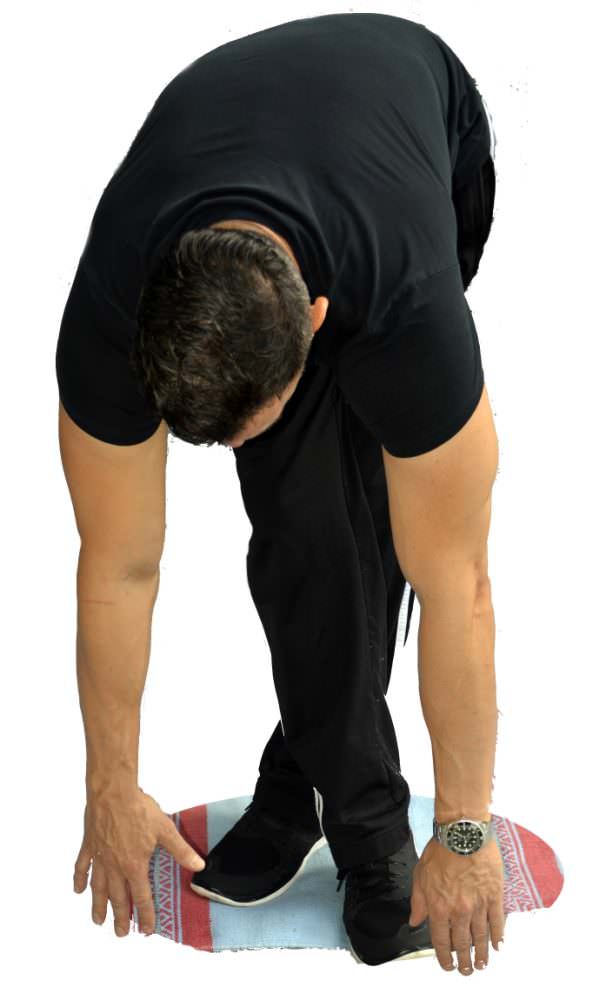
This is a difficult area to stretch directly since the joint itself has very little range of motion — but this stretch provides real relief when the SI joint is irritated: cross the opposite leg over the leg on the affected side while standing, then gently lean forward. Hold for 10-15 seconds. Be gentle — you’re trying to wring inflammation out of the surrounding muscles and joints, not force anything. See more lower back stretches →
Core Stability Work
The SI joints are central to core function, and core exercises — stability ball work, balance training, and targeted abdominal exercises — help keep the joints flexible and functioning well, reducing the likelihood of future SI sprains.
Frequently Asked Questions About SI Joint Pain
Feel along your back at belt-line level, about two to three inches off center on either side — the bump you feel there is the top of the SI joint, continuing down for about four inches. There are two SI joints, one on each side, connecting the base of the spine to the pelvis.
Typically pain on one side of the lower back at or near belt-line level, often radiating into the buttock and sometimes the front of the thigh. It commonly worsens with prolonged sitting, standing up from a seated position, or single-leg activities like climbing stairs. Some patients describe a firm “knot” sensation directly over the joint.
Yes — SI joint dysfunction responds well to chiropractic adjustment, which restores normal joint mechanics and relieves the compensatory strain on the opposite side. Most patients with acute SI joint pain see meaningful improvement within a few visits.
SI joint pain is centered at the joint itself and radiates into the buttock and thigh, but it typically doesn’t follow the specific nerve root pattern or produce the numbness and tingling characteristic of true sciatica, which originates from nerve compression in the lumbar spine. An accurate evaluation distinguishes between the two since the treatment differs.
Yes — this is one of the most common causes. The hormone relaxin loosens the SI joints in preparation for delivery, making them more mobile and more prone to pain and dysfunction throughout pregnancy. Learn more →
This sensation usually reflects recurring SI joint instability or dysfunction rather than the joint actually dislocating. Underlying causes — muscle imbalance, leg length discrepancy, core weakness, or a joint that hasn’t fully stabilized after a previous injury — need to be addressed directly rather than just repeatedly “resetting” the joint, or the pattern will keep recurring.
A gentle cross-body stretch: cross the opposite leg over the affected side while standing and lean forward slightly, holding 10-15 seconds. The SI joint itself has very little range of motion, so stretching provides modest relief — chiropractic adjustment addressing the joint directly is more effective for lasting resolution.
Schedule SI Joint Treatment in Norwalk, CT
If you’re dealing with lower back, hip, or buttock pain that seems tied to the SI joint, Dr. French’s Norwalk, CT office offers a thorough evaluation to confirm the diagnosis and begin treatment.
Call (203) 939-9700 or book online. Located at 148 East Avenue, Suite 1D, Norwalk, CT 06851 — I-95 Exit 16, free parking.
Serving patients from Norwalk, Westport, Wilton, Darien, New Canaan, Weston, and Stamford.